
You didn’t plan a trip to Qatar. Your flight did. And now you’re standing at Hamad International Airport with a boarding pass for tomorrow, wondering whether it’s worth leaving the terminal at all.
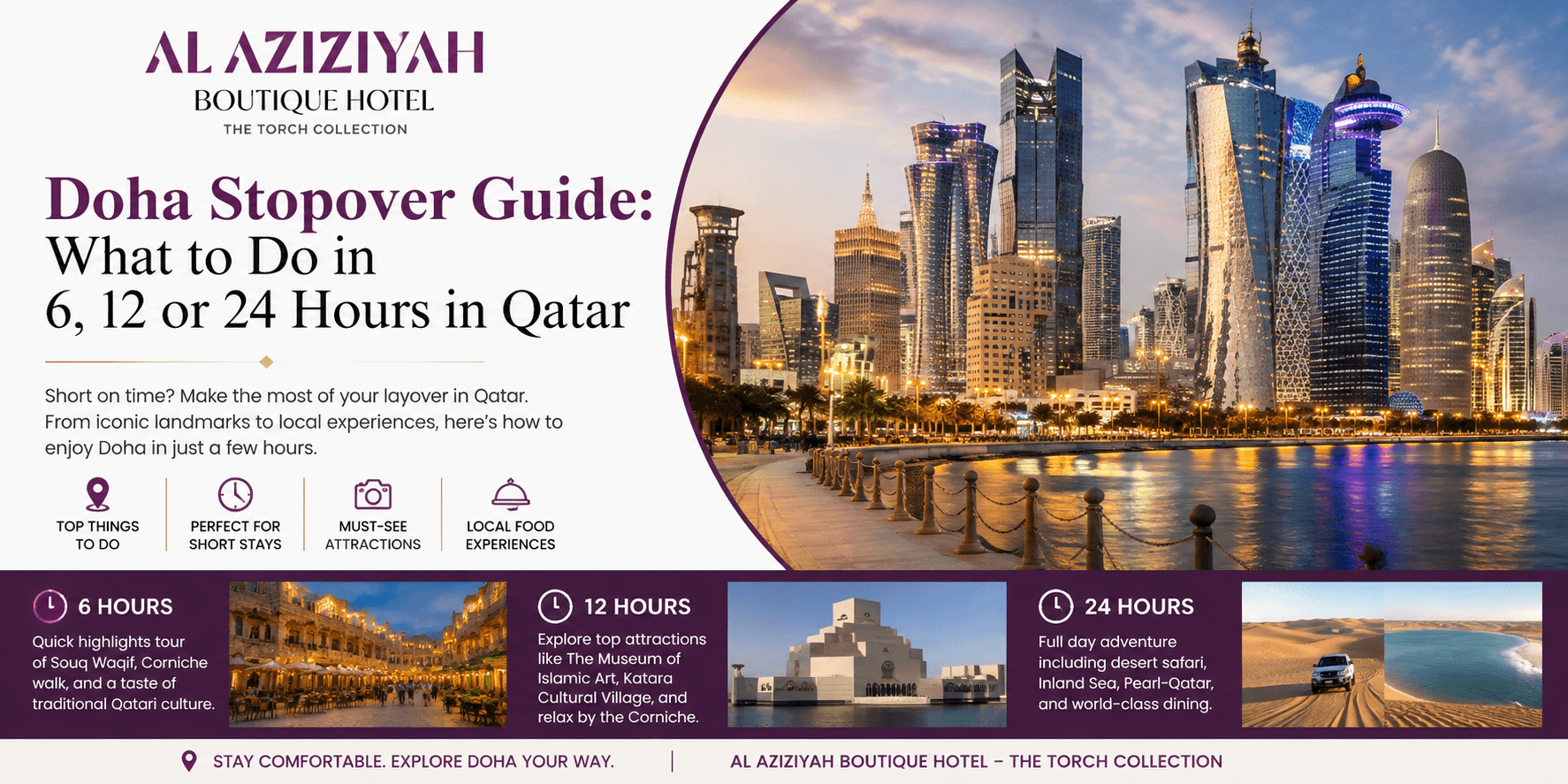
It is, but only if you plan around the time you actually have, not the Doha you wish you had time to explore. A short layover can still give you a taste of Qatar’s culture, food, skyline, and famous hospitality, but only when you choose wisely. Instead of rushing from Souq Waqif to the Corniche, museums, and restaurants all in one afternoon, build your plans around your schedule. Whether you have six hours, twelve hours, or a full day, this guide shows you how to make every hour of your Doha layover count and where a comfortable stay like Al Aziziyah Boutique Hotel can turn an unexpected stop into a memorable mini-break.
How to Read This Guide (And Why Time, Not a Checklist, Should Drive Your Plan)
Most “things to do in Doha” lists are written for people staying a week. A Doha layover guide needs a different logic. Every recommendation here accounts for immigration, transfer time, and the return trip to the airport because missing a connecting flight to see one extra landmark is never worth it.
Before anything else, three numbers matter: how many hours you have between landing and your next boarding time, how far your destination is from Hamad International Airport, and how much buffer you need to clear security again. Everything below is built around those three numbers.
Before You Leave the Airport: What Every Transit Passenger Should Know
Direct answer: Whether you can leave Hamad International Airport during your layover depends on your nationality, your ticket, and how much time you have, not just on wanting to.
Some travelers can transit through Qatar without ever clearing immigration, staying entirely within the airport’s international transit area. Others are eligible to leave and explore the city for part of their layover, sometimes through Qatar Airways’ own stopover programs. Entry rules, visa-on-arrival eligibility, and transit visa policies vary by passport and do change, so this guide will not state specific eligibility rules as fact. Always confirm your entry requirements with Qatar’s official immigration authority (MOI) or Hamad International Airport before you land, ideally while you’re still able to check your airline’s stopover terms online.
What’s true for almost everyone: if you plan to leave the airport, build in real buffer time. Immigration queues, a 20–30 minute transfer into the city, unpredictable traffic, and re-clearing security before your gate can easily eat 90 minutes to two hours combined on top of however long you spend sightseeing.
How Much Time to Allow Before Your Next Flight
A safe rule of thumb: don’t plan to be back at the gate later than 90 minutes before departure, and add extra padding if your flight is an early morning or late evening departure when roads or immigration lines may behave differently. A 6-hour layover should be treated very differently from a 24-hour stopover; the shorter the window, the smaller and closer your plan needs to be.
What to Do in Doha in 6 Hours
Direct answer: With six hours, pick exactly one nearby experience, keep your food simple, and treat the return trip as non-negotiable.
Six hours sounds like plenty until you subtract immigration, transfer time, and the mandatory return buffer; realistically, you’re left with two to three hours in the city itself. This is not enough time to “see Doha.” It is enough time to get one genuine taste of it.
Airport arrival and immigration: Clear immigration promptly and head straight for transport;t a taxi or ride-hailing app is more predictable than public transit when your clock is this tight.
Where to go: Souq Waqif is the strongest single choice for a 6-hour window. It’s a compact, walkable heritage market close enough to the airport to justify the trip, and it delivers food, culture, and photography in one stop without requiring a second destination.
Quick meal: Eat inside the souq itself rather than searching for something else, so you’ll save the travel time you don’t have.
Return to the airport: Leave with a firm cutoff time in mind, not a “one more alley” mentality. A 6-hour stopover has almost no margin for a delayed taxi.
Why not try to add the Corniche or a museum too? Because a rushed version of three attractions is a worse experience and a bigger risk than a relaxed version of one.
What to Do in Doha in 12 Hours
Direct answer: Twelve hours gives you room for one cultural landmark, a walk along the waterfront, and a proper meal without racing the clock.
This is where a Doha layover itinerary starts to feel like an actual visit rather than a detour.
Culture first: Start at the Museum of Islamic Art or Msheireb Downtown Doha, depending on whether you prefer art and architecture or a walk through the city’s modern heritage district.
Doha Corniche: The waterfront promenade connects naturally to the museum area on foot or by a short taxi ride, and it’s one of the best places to see the West Bay skyline without needing extra time set aside for it.
Souq Waqif and dinner: Close the day here. It’s central, easy to reach from the Corniche, and gives you dinner, shopping, and atmosphere in one stop.
Short shopping or café stop: If you have any buffer left, a coffee stop inside the souq or a quick browse of its shops rounds out the day without adding travel time.
Twelve hours is enough for culture, waterfront, and food but still too tight for The Pearl-Qatar or Katara Cultural Village on top of everything else. Pick depth over breadth.
What to Do in Doha for 24 Hours
Direct answer: A full 24-hour stopover is enough to genuinely experience Doha: one heritage morning, one museum, a waterfront afternoon, and an evening in Souq Waqif, with room to breathe between each.
This is the version of a Dohaone-dayy itinerary where you’re not sprinting.
Morning: Breakfast and a cultural anchor: Start with breakfast near Msheireb Downtown Doha, then spend an hour or two exploring the district’s mix of restored heritage houses and contemporary architecture.
Late morning Museum or heritage area: Head to the National Museum of Qatar, whose distinctive desert-rose architecture sits right on the Corniche, making it easy to combine with your afternoon waterfront walk.
Afternoon Lunch and city exploration: Have lunch nearby, then use the early afternoon for a slower loop through the city; ty this is the point in the day with the most flexibility.
Late afternoon Corniche or waterfront: As temperatures ease later in the day, the Corniche becomes one of the more comfortable places to walk, with West Bay’s skyline as a backdrop.
Evening Souq Waqif and dinner: Arrive as the light starts to fade. This is when the souq is at its liveliest, with restaurants, spice stalls, and falconry shops all open.
Night Skyline or a relaxed close: Finish with a view of the West Bay skyline from the Corniche, or, if you’d rather unwind than keep moving, retreat to a hotel for the night before your onward flight.
With a full day, Katara Cultural Village or The Pearl-Qatar become realistic add-ons if you’re traveling light on luggage and comfortable with a bit more transit time,e but they’re the first things to cut if your day runs long.
Doha Stopover Planning Table
| Stopover Length | Best Places to Visit | Recommended Experience | Travel Style |
|---|---|---|---|
| 6 Hours | Souq Waqif | One focused cultural stop with food | Fast, minimal transfers |
| 12 Hours | Museum of Islamic Art or Msheireb, Doha Corniche, Souq Waqif | Culture, waterfront walk, dinner | Balanced, one loop |
| 24 Hours | Msheireb, National Museum of Qatar, Corniche, Souq Waqif, optional Pearl-Qatar/Katara | Full-day cultural and waterfront circuit | Relaxed, spaced out |
Suggested Itinerary Snapshot
| Time Available | Suggested Plan | Main Highlight | Food Stop |
|---|---|---|---|
| 6 Hours | Airport → Souq Waqif → Airport | Souq Waqif market walk | Lunch inside the souq |
| 12 Hours | Museum/Msheireb → Corniche → Souq Waqif | Museum of Islamic Art or Msheireb | Dinner in Souq Waqif |
| 24 Hours | Msheireb → National Museum → Corniche → Souq Waqif → skyline view | National Museum of Qatar | Breakfast near Msheireb, dinner in Souq Waqif |
What to Eat During a Doha Stopover
Direct answer: For short layovers, eat inside Souq Waqif; for longer stopovers, branch out to try Qatari dishes like machboos or harees alongside the wider Middle Eastern food scene.
Doha food doesn’t require a hunt. Souq Waqif alone has enough restaurants Qatari, Lebanese, Turkish, Iranian, and pan-Middle Eastern to cover a meal at almost any hour, which makes it the default answer for where to eat during a Doha layover.
If you have more time, look specifically for traditional Qatari cuisine: machboos (spiced rice with meat or fish), harees (a slow-cooked wheat and meat dish), and balaleet (sweet vermicelli, often served for breakfast) are dishes you’re less likely to find outside the Gulf. For a 6-hour stopover, keep it simple: a shawarma or a quick plate inside the souq will taste better with time pressure removed than a longer meal you have to cut short. For 12- or 24-hour stopovers, a sit-down Qatari meal is worth the extra 20–30 minutes it takes.
Where to Rest or Stay During a Longer Layover
Direct answer: If your stopover runs 12 hours or longer,r especially overnight,t a hotel stay is usually more restorative than trying to fill every hour with sightseeing.
Not every long layover needs to be spent walking. If your flight lands late at night or your connection isn’t until the following afternoon, resting properly can matter more than ticking off another landmark.
Al Aziziyah Boutique Hotel, set in Doha’s Aspire Zone, is one option for travelers with a longer stopover who’d rather unwind than rush between attractions. Its Victorian-style rooms and gardens sit around 25 minutes from Hamad International Airport, with Villaggio Mall, the Qatar Equestrian Federation, and Education City nearby a quieter, more residential contrast to the density of downtown Doha and the Corniche. It’s a reasonable choice if your priority is genuine rest rather than another item on the itinerary; it isn’t the only option near the airport, so weigh it against your own timing, budget, and how close to the airport you want to stay.
As a general rule: the shorter your layover, the more an airport hotel or airside rest area makes sense; the longer it is, the more a proper hotel, even one a short drive from the terminal,l pays off in actual sleep.
Weather and Timing: When to Walk, When to Stay Indoors
Direct answer: Doha’s climate is generally hot for much of the year, so outdoor sightseeing is more comfortable earlier or later in the day, with indoor attractions like museums and malls a better fit for the hottest hours.
Exact conditions vary by season, so check the forecast for your travel dates rather than relying on general assumptions. As a working guideline: plan outdoor time on the Corniche, walking through Souq Waqif’s open lanes for the morning or evening, and treat museums, malls, and covered market sections as your midday fallback. Light, breathable clothing and carrying water are sensible defaults year-round, and if you’re walking for an extended stretch, pace yourself rather than treating a layover like a race against the itinerary.
Local Travel Tips by Traveler Type
- First-time visitors: Souq Waqif and the Corniche give the clearest sense of the city in the least time.
- Couples: An evening Corniche walk paired with dinner in the souq is Doha’s most natural date-night stopover combination.
- Families: Msheireb Downtown Doha and the Corniche are the most stroller- and kid-friendly options; save the souq’s busiest evening hours for older children.
- Solo travelers: Six or twelve hours works well. Solo, Souq Waqif is easy to navigate alone and safe to explore at a relaxed pace.
- Food lovers: Prioritize a 12- or 24-hour window so you have time for a proper Qatari meal, not just a quick bite.
- Travelers with limited mobility: Msheireb and the Corniche are the flattest, most accessible options; Souq Waqif’s stone lanes are walkable but uneven in places.
- Travelers arriving late at night: Consider resting first, especially if your stopover extends into the next day; a fresh start beats a sightseeing trip on no sleep.
- Travelers with children: Build in extra buffer time everywhere; a 6-hour layover with young kids is better spent close to the airport than attempting a full city loop.
How to Avoid Wasting a Short Doha Stopover
The single biggest mistake travelers make is treating a 6-hour layover like a 24-hour one. Pick fewer destinations, not more. Confirm your transit or entry requirements before you land, not at the immigration desk. And always build your return-to-airport buffer around your actual flight time, not around how much more you’d like to see.
Key Takeaways
- A Doha layover works best when the plan matches the hours available;e six hours means one destination, not four.
- Souq Waqif is the most reliable choice for short stopovers; the Corniche and major museums fit better into 12- or 24-hour windows.
- Confirm entry and transit visa requirements with official Qatar sources before leaving the airport.
- Build in real buffer time for immigration, transfers, traffic, and security, ty not just sightseeing.
- Longer layovers are a legitimate reason to rest at a hotel rather than sightsee non-stop.
Conclusion
A Doha layover isn’t a consolation prize for a delayed connection; it’s a compressed, genuinely rewarding way to experience Qatar, as long as the plan respects the clock. Six hours means one good destination and a firm return time. Twelve hours means culture, water, and food without rushing. Twenty-four hours means a real day in the city, spaced out enough to actually enjoy it. Whichever window you land in, the goal is the same: leave Doha having done less, but done it properly.
FAQs
Can one phone have multiple eSIM profiles?
Yes. Most modern eSIM-compatible phones can store multiple eSIM profiles, although the exact number depends on the device. Usually, only one or two profiles can be active at the same time.
How do you switch between eSIM profiles?
Go to your phone’s Cellular or Mobile Network settings, open the SIM manager, select the eSIM profile you want to use, and activate it. Some devices may require a restart.
Can two eSIMs be active at the same time?
Yes, on supported devices with dual active eSIM. Availability depends on your phone model, software version, and sometimes your carrier.
Does switching eSIMs delete your data?
No. Switching eSIM profiles does not delete your apps, photos, or files. It only changes the active mobile network.
Should you remove old eSIM profiles?
Yes. Deleting unused or expired eSIM profiles helps keep your SIM manager organized and frees storage for new profiles. Save the original QR code before removing a profile.